


- 2026-05-20
- 2026-05-20
- 2026-05-20
- 2026-05-20
- 2026-05-20
- 2026-05-20
- 2026-05-20
- 2026-05-20
- 2026-05-20
- 2026-05-20
?
(1) addition reaction (hydroxymethylation reaction)
amino compounds and aldehydes (mainly formaldehyde) can be carried out under the catalysis of bases or acids. The reaction rate is related to pH, temperature, ratio of reactants and reaction time. In general, when pH = 7, the hydroxymethylation reaction is slower, pH>7, the reaction is accelerated, and when pH = 8~9, the hydroxymethyl derivatives generated are more stable.
(2) polycondensation reaction
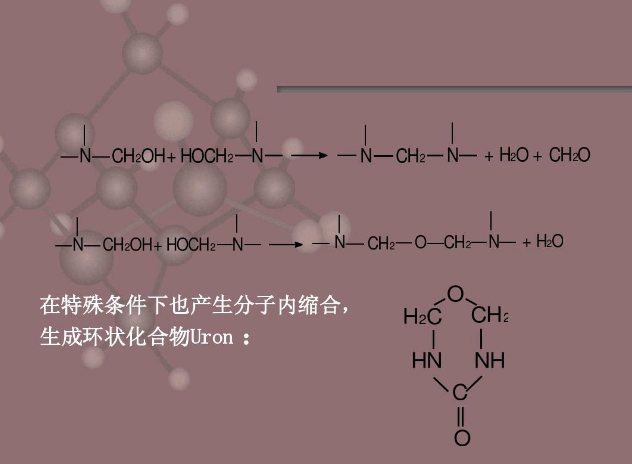
hydroxymethyl derivative can be condensed with an amide group or a hydroxymethyl group of an amino compound in the presence of an acidic catalyst to form a methylene bond.
, the more hydroxymethyl derivatives containing hydroxymethyl groups, the slower their intermolecular polycondensation reaction. On the contrary, the less hydroxymethyl group, the more active hydrogen atoms in the molecule, the faster the intermolecular polycondensation reaction.
(3) etherification reaction
hydroxymethyl derivative oligomers are hydrophilic and insoluble in organic solvents, and therefore cannot be used for coatings. Therefore, it must be modified by alcohol etherification. The etherified resin has a certain number of alkoxy groups, which reduces the polarity of the original molecules and obtains solubility in organic solvents, and is used as a coating crosslinking agent.
is etherified with methanol, the resin is water-soluble and fast, and can be used as a crosslinking agent in water-based coatings; it can also be used in combination with solvent-based alkyd resins. The resin etherified with ethanol is soluble in ethanol, and its curing speed is slower than that of the methyl etherification product. The resin etherified with butanol has good solubility in organic solvents. Etherification with octanol, because of its own polarity is small, and methylol (-CH2OH) reaction is slow, so first with lower alcohol (methanol or butanol) etherification, and then with octanol by ether exchange reaction, in order to produce octaneated resin. It can be seen that the longer the molecular chain of the unit alcohol, the better the solubility of the etherate, but the slower the curing speed.
butanol etherification of the resin in solubility, miscibility, curing, film performance and cost are ideal, and because of the raw materials are readily available, the production process is simple, so with the solvent-based coatings with the crosslinking agent is often used butanol etherification of amino resin. The etherification reaction is carried out in excess butanol under weak acidic conditions, and the excess butanol is beneficial to the etherification reaction, and the unreacted butanol can be used as a solvent. It must be pointed out that under weak acidic conditions, the etherification reaction and the polycondensation reaction are carried out at the same time, taking the butyl etherification of urea-formaldehyde resin as an example:
, it is particularly pointed out that in the production of monomeric high alkylamino resins, polycondensation is avoided and the content of free aldehydes in the resin is reduced.


